Websites
Three businesses appear on the little map, and whoever is in it gets the call. Getting there is four or five things done consistently: a claimed listing, one address written the same way everywhere, service pages that name the town, and reviews you asked for in person.
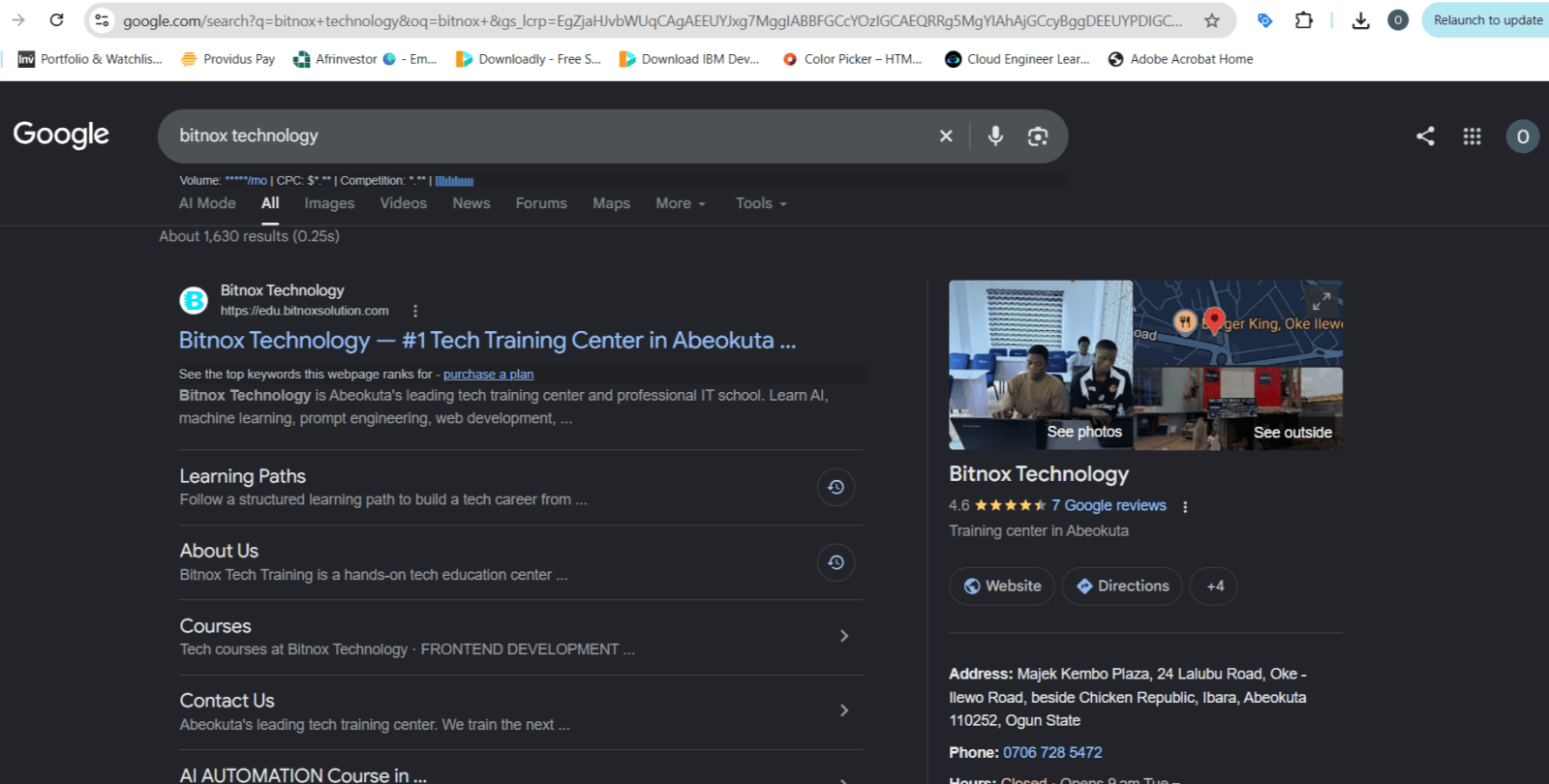
Somebody in Abeokuta needs a printer repaired. They pick up a phone and type printer repair near me. Three businesses appear on a small map, then a list of blue links underneath. Whoever is in that map gets the call, and most of the time nobody below it is rung at all.
Getting into that map is not luck and there is no secret to it. It is four or five things done consistently, and a small business can do most of them without paying anybody.
The map and the links are two different competitions
The map results come from a Google Business Profile, which is a listing rather than a website. The blue links come from your pages. They are ranked on different signals, they are won in different ways, and a business can be first in one and invisible in the other.
For a local trade, the map is worth more. It carries the phone number, the directions and the opening hours, which is everything somebody standing in the street needs. The website is what makes the listing believable, and it is where a search that is not local lands: the buyer in Lagos comparing three suppliers before ringing any of them.
The listing: claimed, complete and current
Most of the ground is made up here, and none of it is technical.
Claim it. A listing can exist without you. If one has been created from public information and nobody has signed in, anybody can suggest an edit and Google may publish what they wrote.
Pick the category a customer would use, not the one you use in a proposal. People search for what they want done, not for the name of your discipline.
Set the opening hours, including the days you are closed. A listing that says open while the door is locked earns a review that says so.
Photographs of the actual place. The front of the building so it can be found from the street, the inside, the work. A profile with a logo and nothing else reads as abandoned.
Answer the questions. Anybody can post one on a listing, and anybody can answer it. Better it is you.
Write the address once, then never vary it
Name, address and phone number have to match between the listing, the site, the footer, the invoice and any directory that carries you. Search engines read all of them and treat agreement as confirmation. Two spellings of the same street look like two businesses, and confidence in both of them falls.
Ours reads:
24 Last Floor, Majek Kembo Plaza, beside Chicken Republic, Lalubu Street, Oke-Ilewo, Abeokuta, Ogun State, Nigeria. +234 813 719 2766.
That exact wording is on the contact page, in the footer of every page, in the structured data the pages carry and on the profile itself. Deciding the wording once and then copying it is the whole technique. The hard part is remembering to copy it in two years, when a new flyer is designed and somebody abbreviates the street.
What the website has to do
Five things, in rough order of how much they matter.
Name the place in the page title and in the first heading. Web development in Abeokuta is a search that people run. Our services is not.
One page per service rather than one page listing all of them. Somebody searching for a single service should land on a page about that one thing, which is why ours are split across /services.
The address as text on the page, not only inside an image or a map embed. Text is what gets read and matched against the listing.
A phone number that is a link on a phone, and an email address that is not hidden behind a form.
Photographs of your own premises and your own work. Stock pictures of somebody else's office in a country you have never visited say nothing about you.
Structured data is worth adding on top: a small block of machine-readable JSON stating the address, the hours and the coordinates so nothing has to be inferred from prose. It does not raise a ranking by itself. It removes ambiguity, and a local result is decided largely on how little doubt there is.
Reviews, asked for rather than bought
Reviews move the local ranking, and then they move the decision that follows the ranking. The way to get them is to ask at the moment the work is finished and the customer is pleased, in person, with the link already open on your phone. That is a habit rather than a campaign, and it is why the businesses with the most reviews are rarely the biggest ones.
Do not buy them. Bought reviews arrive in a batch, from accounts with no history, praising a business in language nobody uses. That is the exact pattern the filters exist to catch, and the profile that suffers is yours.
Reply to the poor ones plainly and in public, without arguing. The reply is not written for the person complaining. It is written for the next customer, who is reading both.
What does not work
A footer listing thirty towns you have never worked in.
Repeating a phrase until the sentence reads badly. Search engines stopped rewarding that a long time ago. Readers never did.
Several listings for one address, created by different staff over the years. Find them, claim them, and have the duplicates merged.
A page per town, made by copying one page and swapping the name. It is obvious to a person and it is obvious to a crawler.
It is slow, which is the reason to start
A listing that has been complete, consistent and reviewed for a year beats one that was tidied up last week. Nothing here produces a result on Friday. All of it compounds, and the businesses that do well in local search are usually the ones that did the boring part earlier than their competitors.
Search is a large part of why the sites we build are shaped the way they are, and the detail is on the web development page. If you would rather have somebody look at what your listing and your pages currently say about you, send us the address and we will tell you what we would fix first.
Filed under
Get the next one by email
What we have built, what we learned building it, and news from the Event Space. A few times a month, and one click to stop.