Strategy
Cloud is a change in who runs the machine, not a change in whether you need one. Backups, email and the website move first. Hardware-tied systems and anything that has to work during an outage do not. What it does to your bill, your connection and your exit.
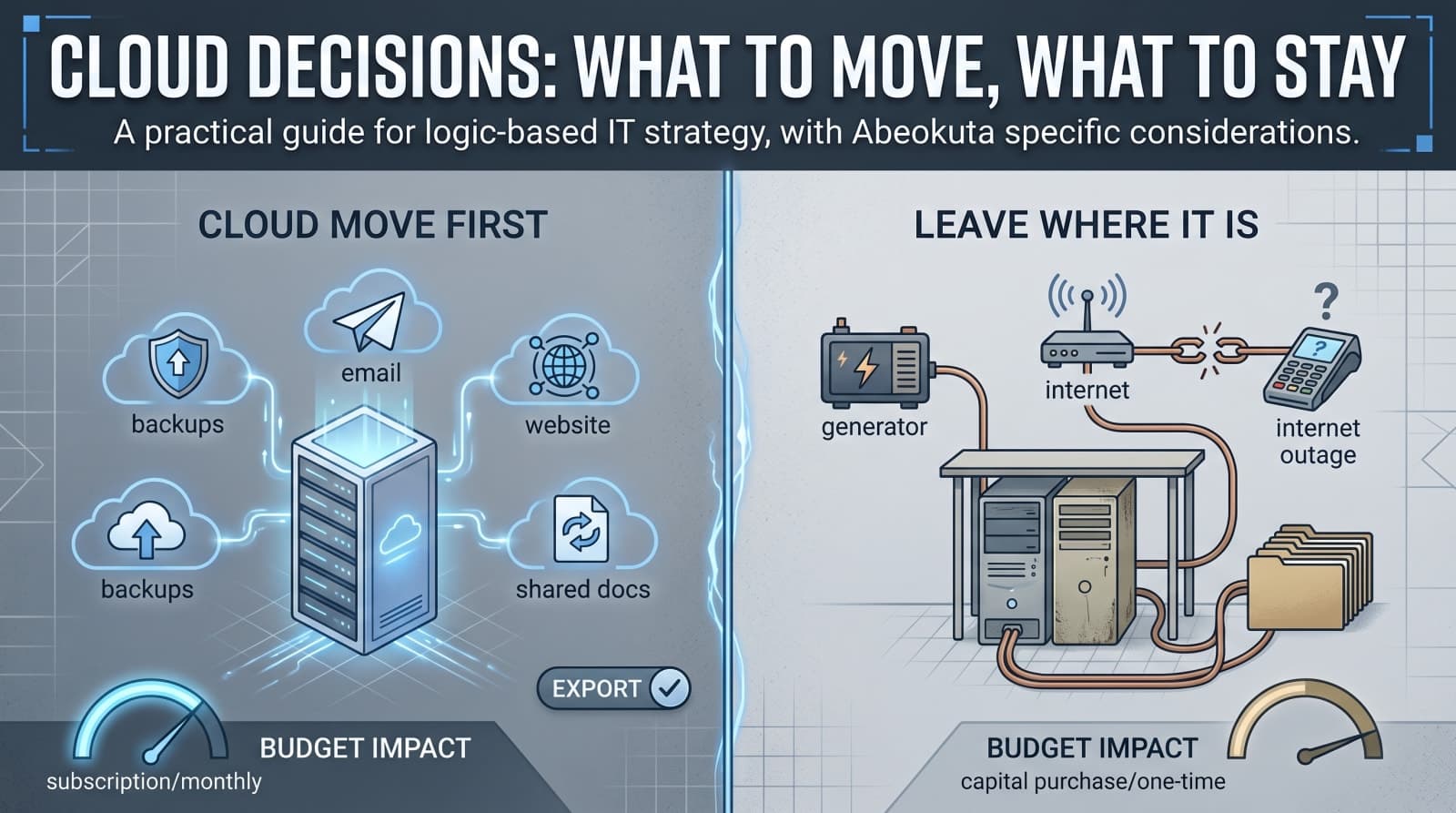
Moving to the cloud is a change in who runs the machine. It is not a change in whether you need one, and it is not automatically cheaper or safer. Sometimes it is clearly worth paying for and sometimes it is clearly not, and the answer is different for each system rather than for the business as a whole.
In Abeokuta the sum has two terms that a template written elsewhere leaves out: mains power and the internet connection. Both belong in the decision.
What you are actually buying
Somebody else's power, cooling and hardware replacement, which in a Nigerian office is a real line item rather than a footnote.
Capacity you can change in a day instead of ordering a machine and waiting for it to clear.
A monthly cost in place of a capital purchase you depreciate over five years.
Somebody to ring at two in the morning, if the plan you chose includes that. Many do not.
What you are not buying is safety. A server in a data centre with no backups is exactly as lost as a server under a desk with no backups. Where the machine sits and whether the data survives are separate questions, and only one of them is answered by moving.
Move these first
Backups. The copy that is somewhere else is the copy that survives a fire, a theft or a flood. If you do only one thing on this page, do this one.
Email. Rarely worth running yourself. Getting mail delivered rather than filtered is a full-time discipline, and a provider does it for the price of a coffee per person.
The website. Pages generated ahead of time and served from a network with points around the world reach your visitors faster than a machine in the office ever will, and it takes the traffic off your connection.
Shared documents. Two people editing one file was the problem, and it was solved a decade ago. The version named final-updated-2 is a symptom worth curing.
Think harder about these
Work that moves large files all day: video, photography sets, drawings. The upload is the bottleneck and upload is the slower direction on most connections here.
Anything wired to hardware. A point of sale, a card machine, cameras, a machine on the workshop floor. Putting the brain in another country and leaving the hands in the building is a decision to make deliberately.
Anything that has to work while the connection is down. If the shop cannot sell during an outage, the till does not belong entirely online.
Records you are obliged to keep for a set number of years. Keep a copy you hold yourself, whatever the supplier promises.
The connection becomes the single point of failure
Once the systems are elsewhere, an internet outage stops being an inconvenience and becomes a closure. Two things follow from that.
The first is a second connection from a different provider, ideally not arriving by the same road or the same mast, with a router that fails over without somebody typing a password. The second is an honest answer to how long the business can trade with no connection at all. Write the answer down. If it is zero, that decides which systems keep a local mode, and it is cheaper to decide now than during the outage.
The bill changes shape
A purchase becomes a subscription, which is easier on the first year and different afterwards. Two things to check before signing.
What is metered. Storage is usually cheap and predictable. Data leaving the service, and per-user pricing, are the two lines that grow in ways people did not plan for.
What it looks like at twice your current headcount. A price per person is a hiring cost, and it should be modelled at the size you are aiming for rather than the size you are.
Leaving is a feature, so test it first
Before you move a system, find the export. Not the promise of an export in the documentation, the actual button or command. Run it once, open the file, and confirm it contains what you would need to start again somewhere else.
A supplier who cannot produce your data in a format you can read is selling you a lock as well as a service. The time to discover that is before the data is theirs.
A sensible order
Backups, then email, then the website, then documents, then everything else case by case. One at a time, with a fortnight between each, so that when something goes wrong you already know which change caused it. A weekend where four systems move at once is a weekend nobody in the business remembers fondly.
Working out which of your systems belong in which list is most of what an IT consulting engagement does in its first fortnight. If a decision like this is in front of you now, tell us what you run and we will tell you what we would move first.
Filed under
Get the next one by email
What we have built, what we learned building it, and news from the Event Space. A few times a month, and one click to stop.